

Making ESG More Engaging: Climate Change Needs Better Storytelling
How better storytelling and a touch of humour can bring ESG and climate conversations to life.

Let’s be honest, sustainability and climate change don’t always make for the most thrilling read. I’m a sustainability consultant and I know how hard it is to get the message across. It feels like trying to sell ice cream during a blizzard. Between the jargon, targets, and acronyms, it can feel like homework. Yet these stories shape everything from the food we eat to the air we breathe. So how can we make the conversation more engaging?
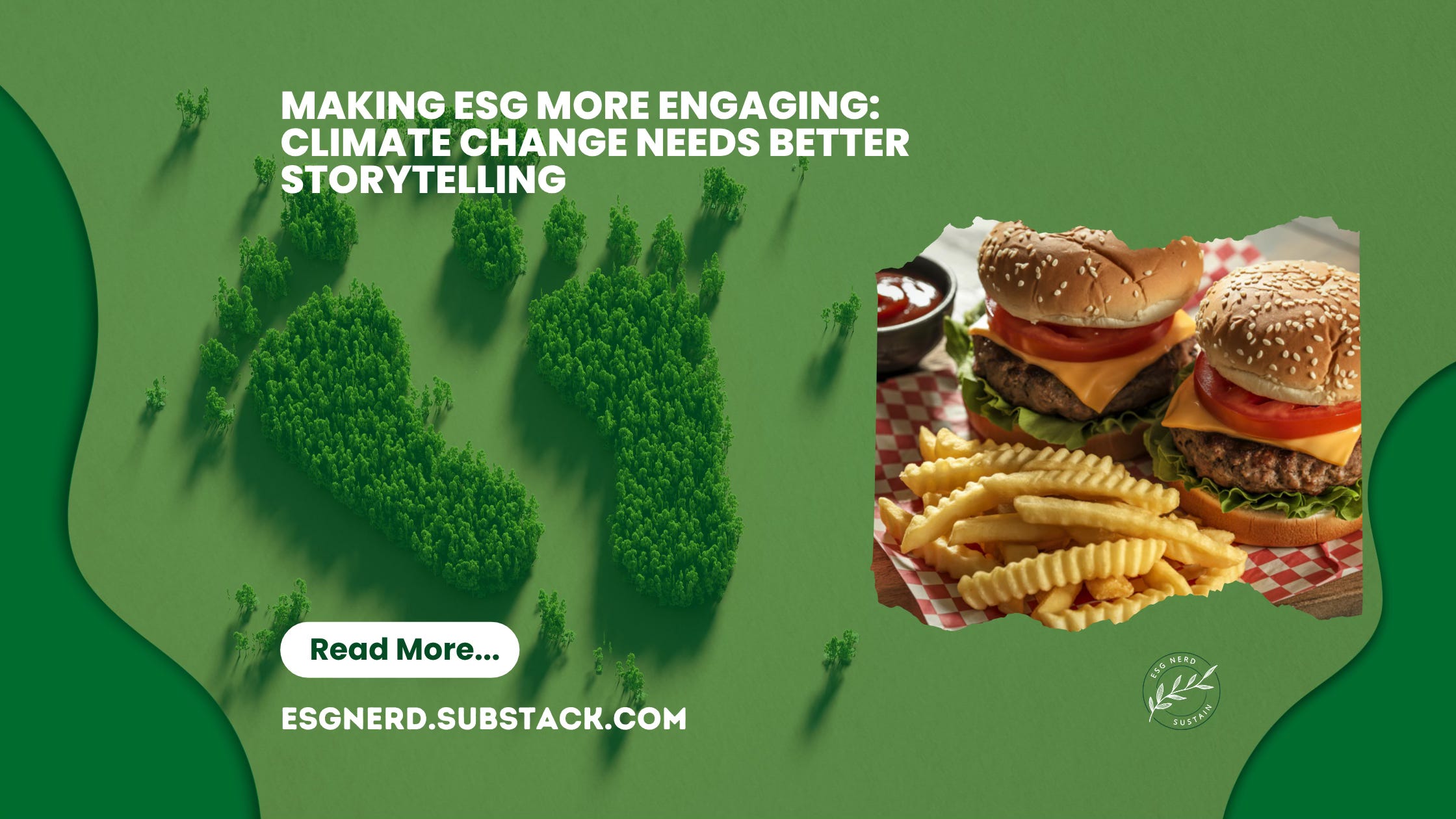
While many companies and individuals are doing their bit to reduce their impact on the planet, the President of the United States seems determined to do the opposite. His carbon footprint isn’t exactly a size seven. Why do I mention this? He’s a prominent leader and people tend to listen to him, whether his points are valid or not.
For anyone wondering, a carbon footprint is simply the total amount of greenhouse gases (mainly carbon dioxide) produced by our actions, from flying and driving to heating our homes and powering our tech. If we all behaved like Donald, the world’s temperature chart would start to look alarmingly similar to the top of the Scoville scale, that’s the one used to measure how hot chillies are.
So, this week on ESG Nerd, we’re tackling the latest sustainability stories in a way that keeps things real, a little humour, a little hope, and a reminder that the topic matters more than ever.
No Sector Is on Track to Meet 1.5°C Targets
A global review by the World Resources Institute has revealed that not one sector is aligned with the goals needed to limit warming to 1.5 °C. Out of 45 indicators, none are on pace for 2030. I’m not surprised by this statement.
All systems are flashing red,” said Clea Schumer, Research Associate at WRI and co-lead author of the report. “A decade of delay has dangerously narrowed the path to 1.5°C. Steady progress isn’t enough anymore — every year we fail to speed up, the gap widens and the climb gets steeper. There’s simply no time left for hesitation or half measures.
Takeaway: ambition isn’t the issue, implementation is.
Why aren’t we closing the gap? One argument is money. There’s a lot of cash to be made in doing what you want and trying to get away with it. There’s plenty more in the assurance and verification process of climate change. That’s a lot of headaches.
Europe’s Environment: Still Under Pressure
The European Environment Agency warns that while progress has been made on emissions and pollution, Europe’s natural systems remain in decline, a bit like my team Sheffield Wednesday.
The EEA reports that despite making good progress in increasing air quality, the region faces degradation, overexploitation and biodiversity loss.
Takeaway: this isn’t a distant crisis, it’s happening on our doorstep, from urban air quality to collapsing biodiversity.
What can we do? More is being made of turning the tide on biodiversity loss. Every small action can help make a difference, from planting pollinators in your back garden to the protection of national parks and wetlands.
Corporate Climate Goals: Promise or PR?
From Microsoft’s rising emissions despite climate pledges to Unilever’s partial progress, big brands are facing a reckoning between claims and outcomes.
Large corporations will always tell us what we want to hear. McDonald’s, Burger King, Five Guys and the other major global meat sellers aren’t telling you about the negative impacts of cattle ranching. Pickle? Yes, it appears we are in a bit of one.
Imagine telling Donald Trump that his favourite burger is having a negative impact on the planet. I bet a few dollars that he’d rant about the statement on social media. His chef would certainly be fired!
I can picture him on the podium. “From tomorrow, we’re celebrating National Burger Day. Monday to Sunday. Burgers are the cornerstone of a good old fashioned American diet.”
Grab an aspirin, because here’s the headache. Reducing meat consumption globally is like trying to push the Mississippi River back into the Lake Itasca. It seems like an impossible task.

Deforestation for cattle pasture is a major climate driver. In the Amazon Rainforest region, cattle ranching is the leading cause of clearing, responsible for an estimated 340 million tons of carbon released annually, roughly 3.4% of global emissions. WWF
Takeaway: the question isn’t whether business is trying, it’s whether their actions add up.
If we told these stories differently with clarity, curiosity, and a touch of humanity, could we inspire more people to care?
Just imagine if a burger came with a calorie count and a carbon footprint figure. Would people care? Would they understand? It’s a bit like politics, vague, misleading and something that gets in the way of doing the things we enjoy.
It’s all food for thought.
Reader question:
What would make you want to read more about sustainability? Are you drawn to stories of hope, local change, or practical examples you can use at home or work?
Thank you for subscribing to ESG Nerd, I am off to ditch my day job for the comedy clubs of West London. Have a great day.